
ADHD - Attention-Deficit Hyperactivity Disorder

ADHD - Attention-Deficit Hyperactivity Disorder

ADHD - Attention-Deficit Hyperactivity Disorder
ADHD - Attention-Deficit Hyperactivity Disorder
ADHD - Attention-Deficit Hyperactivity Disorder
ADHD - Attention-Deficit Hyperactivity Disorder
Attention-Deficit/Hyperactivity Disorder (ADHD) is a neurodevelopmental condition that affects attention regulation, impulse control, and activity levels. It's one of the most commonly diagnosed conditions in children, but it doesn't stop at childhood — many people are first recognised as adults, often after years of unexplained difficulties with focus, organisation, or emotional regulation.
ADHD isn't a single, uniform experience. Clinically, it's understood across three symptom domains — inattention, hyperactivity, and impulsivity — and most people present with a mix of these rather than a "pure" type. A child who struggles to sit still in class and an adult who consistently misses deadlines despite genuine effort may both be describing the same underlying condition, just expressed differently across different life stages and demands.
Presentation varies significantly by age, sex, and individual circumstances. Hyperactivity is often more visible in younger children, while inattentive symptoms can become more prominent — and more disruptive — as academic and workplace demands increase. Girls and women are frequently diagnosed later in life, in part because their symptoms more often present as inattention or internalised struggle rather than the overt hyperactivity that tends to prompt earlier referral. Adults, meanwhile, often arrive at assessment after ADHD has quietly shaped years of work, study, or relationship patterns.
Because ADHD shares features with anxiety, learning difficulties, sleep problems, and other conditions, an accurate diagnosis depends on a comprehensive, structured assessment — not a checklist or a single conversation. At the Behavioural Neurotherapy Clinic, assessment draws on clinical interview, standardised measures, and history from relevant sources, so that any recommendations reflect the individual's actual presentation rather than assumptions about what ADHD "should" look like.
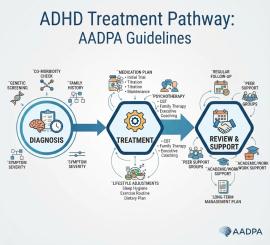
Current best-practice guidelines recommend a multimodal approach — combining strategies rather than relying on any single intervention in isolation. Depending on the person, this may include medication, psychological therapy such as CBT, family-focused support, and practical strategies for daily functioning. What works well for one person may not suit another, which is why treatment planning follows assessment rather than preceding it.
The sections below cover assessment, diagnosis, and specific considerations for children, adults, girls, and women — use them to find the information most relevant to your situation, or get in touch if you'd like to discuss an assessment directly.
Contact BNC to discuss an assessment for yourself or your child.
ADHD assessment waitlists in Melbourne commonly run to 6–12 months at public services and many private practices, which is one of the main reasons ADHD in adults and children so often goes undiagnosed for years.
For decades, ADHD research focused almost exclusively on hyperactive boys. As a result, the condition looks very different from what many people, including GPs and teachers, expect when they think of ADHD.
An ADHD diagnosis in Australia is made by a registered psychologist (with or without a referral from your GP); by a psychiatrist, or paediatrician, following a referral from your GP.
Recognising ADHD in a child can be a confusing and emotional process. You may have noticed your child struggling at school, having difficulty making and keeping friends, or experiencing daily battles over homework and routines.
The Australian Evidence-Based Clinical Practice Guideline for ADHD, developed by the Australian ADHD Professionals Association (AADPA) and endorsed by the National Health and Medical Research Council (NHMRC), sets the national benchmark for… more
ADHD therapy focuses on building practical, everyday skills — attention, planning, self-regulation, and communication — rather than targeting symptoms directly the way medication does.
ADHD is one of the most common neurodevelopmental conditions in adults, yet it remains significantly underdiagnosed. Many adults have lived with ADHD symptoms for decades without knowing, their issues attributed instead to laziness, poor organisation, anxiety, depression or low self-esteem.
The Australian National Clinical Guidelines for ADHD states that "Combined pharmacological and non-pharmacological treatment was better than either alone.
ADHD does not always show up as hyperactivity. Many children diagnosed with ADHD are well-behaved, polite, and have average or even above-average intelligence. Despite this, they may struggle with inattention, distractibility, fidgeting, impulsive mistakes.
You remember everything you were supposed to do, and still forget to do it. You work twice as hard as everyone around you and feel half as accomplished. You've been called "scatterbrained", "emotional", or "too sensitive" so often you've started to believe it.
Disruptive Behaviour Disorders (DBDs) encompass a group of childhood externalising disorders, primarily including ADHD, Oppositional Defiant Disorder (ODD), and Conduct Disorder (CD).