



Child ADHD Assessment and diagnosis in Melbourne: What Parents Need to Know
Recognising ADHD in a child can be a confusing and emotional process. You may have noticed your child struggling at school, having difficulty making and keeping friends, or experiencing daily battles over homework and routines. A formal assessment and diagnosisby a registered psychologist at BNC can provide clarity, and a clear path forward.
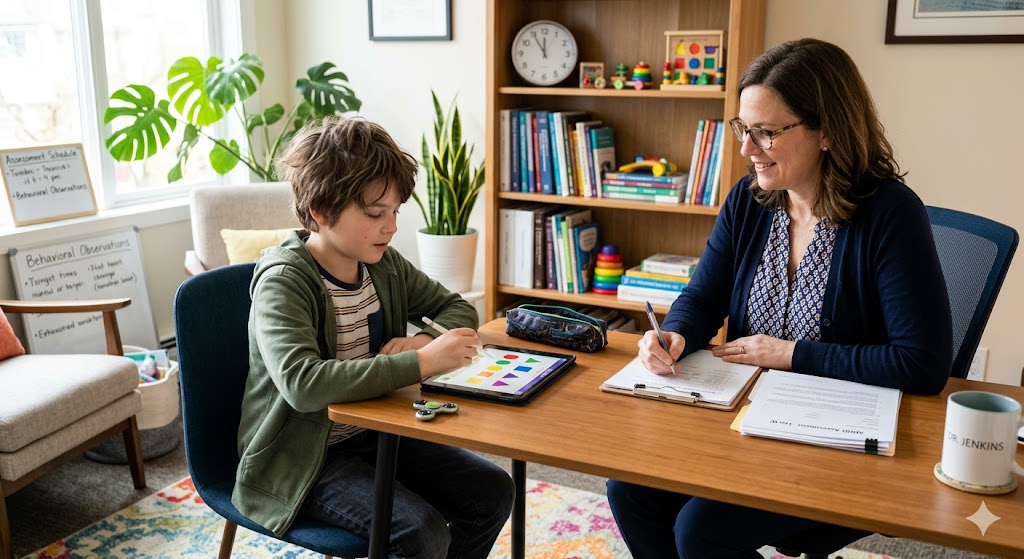
BNC psychologists assess children of all ages
Signs of ADHD in Children
🎯 Inattentive symptoms
- Makes careless mistakes; misses details
- Difficulty sustaining attention in tasks or play
- Seems not to listen when spoken to directly
- Does not follow through on instructions
- Difficulty organising tasks and activities
- Avoids tasks requiring sustained mental effort
- Loses things needed for tasks (pencils, books)
- Easily distracted; forgetful in daily activities
⚡ Hyperactive-impulsive symptoms
- Fidgets or squirms when required to sit
- Leaves seat in class when remaining seated is expected
- Runs or climbs at inappropriate times
- Unable to play quietly
- Talks excessively
- Blurts out answers before questions are finished
- Difficulty waiting their turn
- Interrupts or intrudes on others
Important: An ADHD diagnosis requires that symptoms are significantly more frequent and severe than expected for the child's age, have been present since before age 12, and are causing impairment in at least two settings (such as both home and school).
What Does a Child ADHD Assessment at BNC Involve?
Referral & pre-assessment questionnaires
Following your referral, At your initial appointment, your BNC psychologist will send standardised rating scales for parents and teachers to complete before the next appointment (e.g., Conners-4 or Vanderbilt scales).
Parent clinical interview (Session 1)
A thorough discussion of your child's developmental history, pregnancy, birth, early milestones, medical history, family history, school history and current concerns.
Child assessment session (Session 2-3)
Your psychologist will assign assessments and carry out further investigation of aspects of the behaviours of concern, to screen for other disiiorders whose symptoms overlap with those of ADHD, as they require other therapy options. If necessary, your child may be asked to attend standardised cognitive and neuropsychological testing, including measures of attention, working memory, processing speed, and learning.
Feedback session & report (Session 3-4)
Parents receive a detailed verbal feedback session and a comprehensive written report covering the diagnosis, your child's cognitive profile, and tailored recommendations for home and school.
What to Bring to Your initial session
Note that your child should not attend the initial session. This is to allow you to freely express your concerns without putting undue stress on an already vulnerable child. Your psychologist will guage what your child needs and when fo involve him or her.
- School reports from the past 2–3 years (essential teacher observations from school provide the second-setting data required for diagnosis)
- Your child's teacher's name and email addresss (preferably not a generic school email address)
- Any previous educational, psychological or paediatric assessments
- Completed rating scale questionnaires from BNC (parent and teacher versions)
- A list of any current medications
- Any relevant medical reports (vision, hearing, GP letters)
Teacher questionnaire: Please ask your child's class teacher to complete the teacher rating scale emailed to your child's teacher at your initial interview.
Treatment Options for Children with ADHD
- Behavioural therapy: Working with children and parents to develop practical management strategies
- Parent training: Evidence-based programs to help parents manage ADHD behaviours effectively at home
- School liaison: Collaboration with teachers to implement classroom strategies
- Nutritional support: Assessment and guidance on dietary factors affecting attention and behaviour
- Counselling: Support for anxiety, frustration and low self-esteem that often accompany ADHD in children
- Medication referral: Where appropriate, referral to a paediatrician or psychiatrist for medication assessment
Book a Child ADHD Assessment in Melbourne
BNC's registered psychologists assess children of all ages call us to start the process.
Updated on 19/08/2026 by: Dr Jacques Duff PhD- BA Psych; Grad Dip Applied Psychology; FANSA, Clinical Neuroscientist.
Reviewed on 19/08/2026 by: Bernard Ferriere- Clinical Psychologist; BA; Grad Dip Applied Psychology; Dip Clinical Hypnosis; MAPS