
Post-Concussion Syndrome Assessment
When symptoms persist for months, or in some cases years, after a mild traumatic brain injury, a thorough clinical assessment is the first step. At BNC, this typically combines a detailed clinical history and interview, neuropsychological testing, and – where appropriate and with informed consent – QEEG as an adjunct measure. For a general overview of how concussion is diagnosed, see the Mayo Clinic’s overview of concussion diagnosis and treatment.
No DSM-5-TR Criteria for PCS
The DSM-5 (2013) and DSM-5-TR (2022) do not include post-concussion syndrome as a distinct diagnosis. Instead, persistent post-concussion symptoms are generally classified under Major or Mild Neurocognitive Disorder Due to Traumatic Brain Injury.
The DSM-5 eliminated the term "postconcussional disorder," previously found in earlier versions, and now instructs clinicians to diagnose ongoing cognitive symptoms after TBI as "major or mild neurocognitive disorder due to traumatic brain injury" (Frontiers in Neurology; American Journal of Psychiatry; Theravive).
- The DSM-5-TR (2022) continues this classification, and there is no reintroduction of PCS as a separate diagnosis. Instead, it follows the same framework as DSM-5, requiring documentation of cognitive and sometimes behavioral symptoms persisting after TBI, but not labeling them as PCS (Expert Review of Neurotherapeutics).
- Multiple peer-reviewed articles also confirm that, in practice, persistent post-concussion symptoms are either categorized under neurocognitive disorders due to TBI or, depending on the clinical picture, as somatic symptom disorder or other psychiatric diagnoses (L'Encéphale - Elsevier; Psychiatric Annals).
ICD-10 Criteria
The International Classification of Diseases, 10th Revision (ICD-10), by contrast, does recognise Postconcussional Syndrome as a diagnosis (codes F07.81/F07.2) for symptoms that persist beyond the expected recovery window – typically three weeks to three months following head trauma.
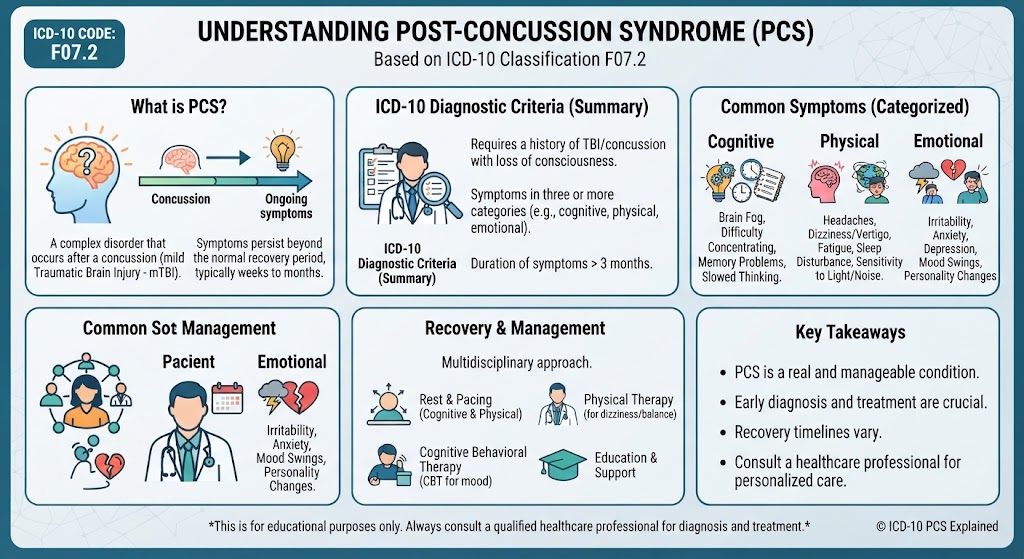
To meet the ICD-10 criteria, a person requires a history of head trauma and at least three of the following symptoms:
- Physical complaints: headache, dizziness, malaise, fatigue, or noise intolerance
- Emotional changes: irritability, emotional lability, depression, or anxiety
- Cognitive complaints: difficulty with concentration or memory
- Insomnia and sleep disturbances
- Reduced tolerance to alcohol or stress
PCS symptoms vary widely between individuals and frequently overlap with other neuropsychiatric conditions. Conventional diagnostic tools remain essential, but on their own do not always capture the full extent of the underlying neural dysfunction – which is why additional testing can add value in more complex or persistent cases.
Neuropsychological Assessment
A neuropsychological battery uses a combination of paper-and-pencil and computerised tests to evaluate attention, memory, language, problem-solving, processing speed and executive functioning. This gives an objective picture of cognitive strengths and weaknesses that can be compared against expected norms for age and background.
Test of Variables of Attention (T.O.V.A.)
The T.O.V.A. is a computer-based continuous performance task that measures attention, impulse control, processing speed and distractibility. It is often used alongside broader neuropsychological testing to build a fuller picture of attentional function after injury.
QEEG as an Adjunct Assessment Tool
In some cases, we may also use QEEG (quantitative electroencephalography, or “brain mapping”) as an additional, adjunct measure alongside clinical assessment and neuropsychological testing. QEEG is not a stand-alone diagnostic tool, and is always used together with, not instead of, the clinical picture. Read our full explanation of what QEEG is, how it’s used at BNC, its usefulness and its limitations.
Frequently Asked Questions
How is post-concussion syndrome diagnosed?+
Is there a blood test or scan that can diagnose PCS?+
What does a neuropsychological assessment for PCS involve?+
Is QEEG used to diagnose PCS?+
How long does an assessment take?+
Updated on: 23/08/2026 by: Dr Jacques Duff – PhD; BA Psych; Grad Dip Applied Psychology; FANSA, Clinical Neuroscientist.
Reviewed on: 23/08/2026 by: Bernard Ferriere – Clinical Psychologist; BA; Grad Dip Applied Psychology; Dip Clinical Hypnosis; MAPS