
Neurofeedback Therapy or Neurotherapy
Summary of ADHD Treatment Guidelines
The 2022 Australian ADHD Professionals Association (AADPA) clinical guidelines provide an evidence-based framework for the diagnosis and management of ADHD in children and adolescents. These guidelines emphasize a multimodal treatment approach tailored to individual needs, combining pharmacological and psychosocial interventions.
Pharmacological Treatment: Stimulant medications, including methylphenidate and dexamphetamine and Vyvanse are recommended as first-line pharmacotherapy due to their strong evidence of efficacy and safety in reducing core ADHD symptoms. Medication should be carefully titrated and monitored, considering potential side effects and coexisting conditions such as anxiety (AADPA, 2022).
Psychosocial Interventions:Behavioral therapies, particularly cognitive-behavioural therapy (CBT), parent training, and school-based support, are essential components of comprehensive ADHD management. These interventions address emotional regulation, oppositional behaviours, and functional impairments, complementing medication benefits (AADPA, 2022).
Lifestyle and Nutritional Considerations: The guidelines highlight the role of lifestyle factors, recommending regular physical activity, sleep hygiene, and nutritional assessment to support symptom management and overall well-being. Dietary interventions should focus on balanced nutrition and correction of deficiencies but are adjunctive rather than primary treatments (AADPA, 2022).
Neurofeedback: While neurofeedback shows some promise as an adjunctive therapy, the AADPA guidelines do not endorse it as a first-line treatment. The AADPA deemed that current evidence is limited by methodological variability and inconsistent outcomes. Neurofeedback may be considered for families seeking non-pharmacological options or when medication is contraindicated or poorly tolerated, but it should be integrated within a broader multimodal plan and delivered by experienced clinicians with ongoing outcome evaluation (AADPA, 2022). Every effort is made to provide eduation about these complementary treatment options so that clients who wish to engage in neurofeedback are aware of the AADPA guideline's position regarding best practice and are aware of the potential benefits and limitations of neurofeedback. Clients are asked to provide their informed consent for neurofeedback in writing.
Neurofeedback
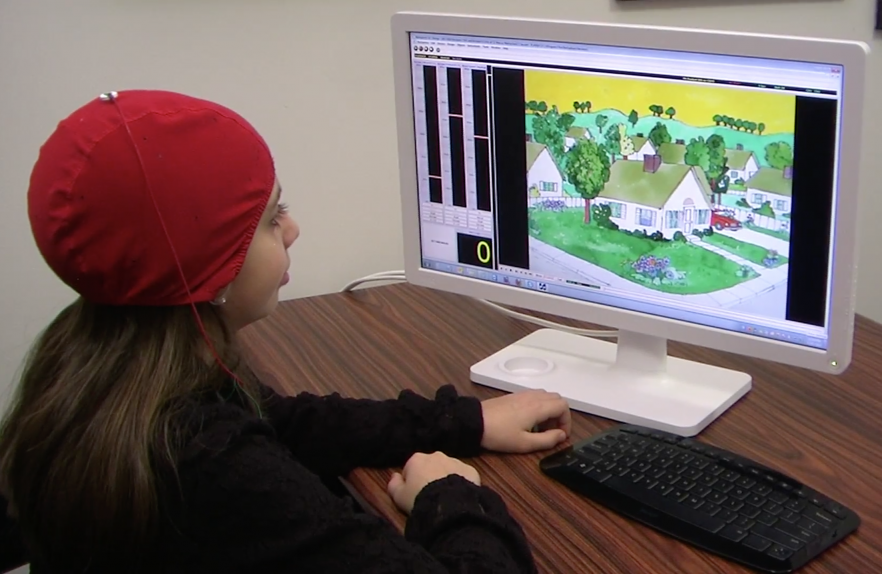
During standard neurofeedback sessions, one or two sensors (electrodes) are positioned on the scalp, with additional electrodes commonly placed on each earlobe. These sensors are connected to an electroencephalography (EEG) system, which non-invasively records electrical activity produced by neural oscillations in the brain.
This process is comparable to a clinician using a stethoscope to monitor cardiac activity through the chest wall. The EEG equipment provides real-time audio and visual feedback reflecting ongoing brainwave activity. At no point is electrical stimulation delivered to the brain. Instead, the device passively records endogenous neural signals, which are transmitted to a computer, analysed, and displayed as graphical representations for review.
Mechanism of Neurofeedback
Typically, individuals are unable to consciously perceive or regulate their own brainwave patterns. Neurofeedback addresses this limitation by presenting real-time (within milliseconds) visual and auditory feedback regarding EEG activity. Through this feedback, individuals can learn to self-modulate specific brainwave frequencies using operant conditioning—a process in which reinforced behaviors become more likely to recur. Early changes in brainwave activity may be short-lived, but with repeated neurofeedback training sessions, these effects can become more sustained. The process relies on continuous feedback, professional guidance, and ongoing practice to facilitate the development of more adaptive brainwave patterns in many individuals.
Updated on: 23/02/2026 by: Dr. Jacques Duff – BA Psych; Grad Dip Psych; PhD; MAPS; MECNS; MAAAPB; MISNR; FANSA
Reviewed on: 24/02/2026 by: Bernard Ferriere - BA; Grad Dip App Psych; Dip Clinical Hypnosis; FCCP; MAPS; MASH; Clinical Psychologist