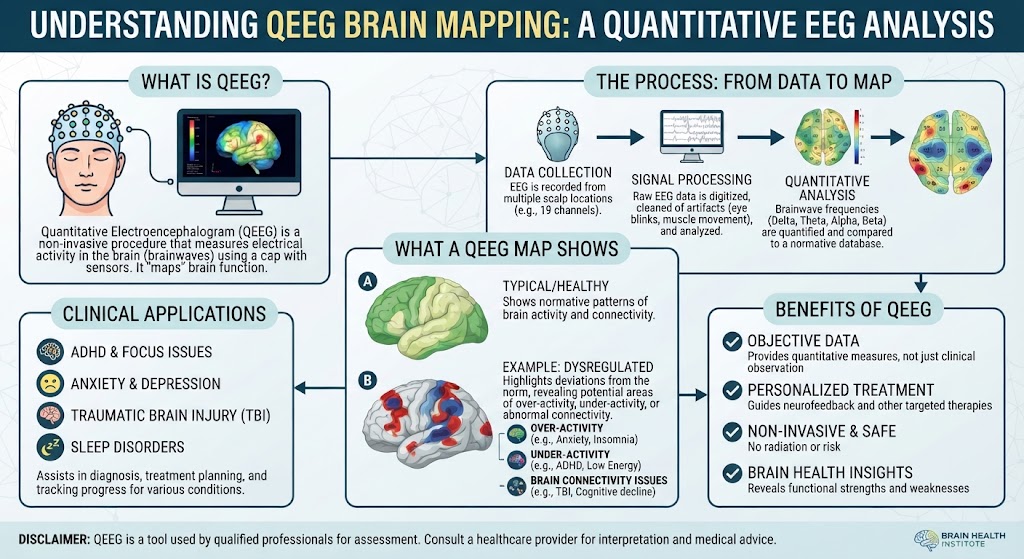
Quantitative EEG
Brain Electrical activity: A historical perspective
As early as 1848, researchers reported the observation of
electrical signals from the nervous system. Animal studies in 1875
proposed similar findings of brain wave activity. Then, however, the
notion that features of measurable electrical activity could
describe brain functions remained relatively obscure for nearly 50
years. Hans Berger then published an article in 1929 describing a
pattern of oscillating electrical activity recorded from the human
scalp.
In the 1930s and 1940s the Electroencephalograph (EEG)
became the object of much interest in the realm of psychiatric and
neurological sciences. Those early studies suggested a preponderance
of certain EEG features in clinical populations compared to normal
individuals. Jasper, et al. (American Journal of Psychiatry, 1938)
reported on an electroencephalographic analysis of behaviour
problems in children that still holds up to scientific scrutiny.
Dawson et al (Journal of Neurosurgery, 1951) reported associations
between EEG and head trauma that are similarly robust in their
longevity. As digital computer technology developed in the 1960s and
1970s, it became feasible to statistically assess and precisely
quantify many more EEG parameters than is possible through human
visual inspection of raw EEG waveforms. Studies reported in this
era, indicating various relationships between brain waves and mental
conditions laid groundwork for the many confirmatory studies that
followed.
| Hirshberg, Chui, and Frazier edited a
special edition of the prestigious journal: Child and
Adolescent Psychiatric Clinics of North America. In this
edition the journal reviewed QEEG and Neurotherapy for ADHD
and Neurodevelopmental disorders.
Click here to
read the preface to this edition. |
Werry et al (1964) reported that EEG data suggest a significant
excess of minor dysthymia and a deficit of centrencephalic and
epileptiform pattern among hyperactives as compared with controls.
Klingerfuss et al (Neurology, 1965) reported on
electroenphalographic abnormalities of children with hyper-kinetic
behaviour. Satterfield et al (1973) reported EEG aspects of minimal
brain dysfunction. In an early study using computerised EEG,
Mechelse et al (Electroencephalography and Clinical Neurophysiology
, 1975), reported on both visual and quantitative analysis of the
brain wave activity of children with and without specific reading
disability. In that same journal (1977), Fuller found that
attenuation of the parieto-occipital alpha rhythm is correlated with
attention deficit. Grunewald-Zuberbier et al (1975) found that, in
periods free from stimulation, hyperactive children have higher
alpha and beta amplitudes, more alpha waves and fewer beta waves,
interpreted as a lower state of EEG arousal in the hyperactives.
Over the past two decades, neuroscientists have conducted an
intense study of the brain's electrical functioning. With the
dawning of the "Digital Age", the "art" of medical specialists who
visually inspect EEG records has been enhanced by the "pattern
recognition" capabilities of a computer technology called "QEEG"
(quantitative electroencephalography).
In the late eighties,
Dr. E. Roy John and his research team at the Brain Laboratories at
New York University Medical Center published what has proven to be
the seminal work in computer-assisted differential diagnosis of
brain dysfunctions. (Science, 1988). Building on that work
researchers, using QEEG and powerful computer analysis, have created
an objective evaluation that is highly sensitive and specific for
assessment and interpretation of human electroencephalography.
Frank H. Duffy, M.D. of Harvard Medical School is thought of as
the father of QEEG. In 1994, Dr. Duffy and other prominent
researchers and clinicians in QEEG prepared a position paper of the
American Medical EEG Association (AMEEGA) presenting the current
status of QEEG in clinical practice. They reported three broad uses
of QEEG in clinical practice, "the first often broadly termed
‘organicity detection,’ the second involving more specific diagnoses
using Discriminant functions, and the third epileptic source
localization via [Dipole Localization Method]."
Selected
diagnoses where the authors suggested QEEG is of use included
Attention Deficit Disorder, Learning Disability, and Traumatic Brain
Injury, including mild head injuries and post concussion syndrome.
They went on to say that QEEG studies are most helpful in
supplementing traditional neuropsychological evaluations of children
with learning disabilities where diagnosis or aetiology remain in
doubt.
In cases of head injury, which results in predictable
QEEG abnormality, the QEEG is often redundant to traditional
electroencephalographic, neurological, and radiographic evaluations.
However, when the head injury is mild, the patient may continue to
be symptomatic, despite normal results of traditional tests. In such
cases, the authors indicated that the outcome of a QEEG study might
greatly assist patient management.
In order to be of
trustworthy value, a test (any test) must possess two critical
characteristics: Validity and Reliability. A test is "reliable" if
it reports the same result upon testing and retesting. For example,
a ruler is a reliable test that yields the same result repeatedly,
or, "reliably." A test is "valid" if it measures what it sets out to
measure. However, the ruler, a reliable measure of length, would not
be considered to be a "valid" test of weight, as it purports to
measure length not weight.
It would appear, then, that QEEG
has been established as a valid test of brain function. Research
also indicates that a highly reliable, precise test can be developed
if brain waves of an individual are compared to well-constructed
statistical databases. This diagnostic procedure yields:
" . . . a level of specificity and sensitivity that is comparable to
sonograms, blood tests, MRIs and other diagnostic measures commonly
used in clinical practice."Robert Thatcher, PhD, Norman
Moore, M.D., E. R. John, PhD, F. Duffy, M.D., et. al. Clinical
Electroencephalography, 1999
The above authors are scientists
responsible for the key databases used by Psychophysiologists and
Clinical Neuroscientists. They are eminent researchers in their
field and conduct their research at Harvard University, New York
University, Veterans' Administration Hospitals, and other leading
medical institutions.
Over the last few years, there has been
wider acceptance of brain wave analysis as a diagnostic technology
in clinical applications. The FDA (US Federal Drug Administration)
regulates the medical devices and methods involved. In addition,
many major insurance carriers in the US now routinely agree to pay
for the procedure.
In 1999, two prominent QEEG scientists,
John R. Hughes, M.D., Ph.D. and E. Roy John, Ph.D., published a
comprehensive review of the scientific literature relating to the
use of QEEG in psychiatry. The article (The Journal of
Neuropsychiatry and Clinical Neurosciences) reviewed over 500
scholarly papers published just in the last decade, relating
specific patterns of abnormality to particular diagnoses.
This article indicates the clinical utility of QEEG as a diagnostic
tool in many mental illness categories. Among these categories, the
literature specifically documents reliable EEG differences between
ADHD and non-ADHD children and shows QEEG Discriminant analysis to
be sensitive and specific to sub-types of ADHD, ADHD versus normal
subjects, and ADHD versus specific developmental learning disorders
(SDLD) individuals. The authors summarised their review of this
voluminous body of literature by stating:
"Evidence has
unequivocally established that 'mental illness' has definite
correlates with brain dysfunction . . . QEEG promises to have
greater expanded use as psychiatrists become more familiar with its
many applications."
"In view of the accumulation of positive
findings surveyed in this article, more psychiatrists may wish to
explore the utility of these methods for themselves and begin to
apply them in their clinical practices."At the same
time, in 1999, the American Psychiatric Press published Psychiatry
in the
New Millennium in which it was contended that,
although new methods for imaging the function of the brain make
headlines and "in spite of their unquestioned potential, these
methods are not adequately represented in daily psychiatric
practice".
Brain wave analysis appears to be the diagnostic
tool of the future for mental health. Nonetheless, it is clear that
what is true of all emerging science will prove to have been true of
QEEG. Early adopters, who are the first to see the advantages of new
technology, will recognise that the technology of brain wave
analysis is a science whose time has come; other, more conservative,
health care practitioners will follow, but more slowly.
Current Physiological Measurements
A number of valuable tests of the brain are currently available:
eg, PET scans, Functional MRI, SPECT Scans, and MEG. Unfortunately,
these tests are costly and, in some cases, there are risk factors
associated with the procedures. For example, consider the PET scan.
A PET scan measures the metabolic activity of the brain and is a
good test for localising regions of altered activity within the
brain. However, PET scans involve the injection of radioactive
labels and are considered unsafe for repeated use over a short time
period or with pregnant women and small children.
Similar
radiation risk, pricing, and limited availability are also true of
other imaging techniques such as rCBF (which measures regional
cerebral blood flow), MEG (which assesses brain electromagnetic
activity), and MRS (magnetic resonance spectroscopy).
Importantly, recent studies have concluded that QEEG findings are
highly correlated with other types of brain analysis. Moreover, with
brain wave analysis, subtle brain dysfunction can be detected that
is not discernible at all with other methods.
It is important
to make a clear differentiation between QEEG tests of the brain and
other commonly used, and perhaps more familiar, imaging techniques
in medicine. For example, x-rays, CAT scans and MRIs are all used to
measure brain anatomy, or structure. The QEEG, on the other hand,
measures brain physiology, or function.
It is also important
to understand that a QEEG is not the same as a "clinical EEG," which
is used in medical practice to evaluate epilepsy or to determine if
there is serious brain pathology, such as a tumor. By contrast, the
QEEG does not assess the structure of the brain, but rather,
evaluates the manner in which a particular person’s brain functions.
It is not designed to diagnose tumors, epilepsy, or other structural
medical conditions.
The report of brain wave analysis is a
diagnostic aid that gives health care practitioners an objective
scientific tool for use in assessing mental health. The report
provides information about exactly what is functionally out of
balance in a given patient’s brain, and, in turn, may be causing
that individual's symptoms. With this more precise understanding of
the underlying physiology, the clinician can make a more confident
diagnosis and determination of the most appropriate treatment.
Diagnosing ADHD in ChildrenProminent in
headlines today are discussions of the mental health of children. It
appears that we are in the midst of an epidemic of Attention
Deficit/Hyperactivity Disorder (ADHD). The National Association of
School Psychologists (N.A.S.P.), and the National institute of
Mental Health (NIH) have warned practitioners of the wide variety of
psycho-medical and bio-medical problems that can be mistaken for
ADHD, or that may co-exist with ADHD, stressing that it is always
essential for a child to be carefully evaluated.
According to
N.A.S.P., ADHD "Look-alikes" include depression, stress-induced
anxiety states, biologically-based anxiety disorders, bipolar
disorders, schizophrenia, and other medical disorders. While
children with look-alike disorders may fulfil the diagnostic
criteria for ADHD, they may have an entirely different underlying
physiological condition and, therefore, might more appropriately
receive a different diagnosis, resulting in different treatment.
Moreover, if a medical or other psychiatric disorder is presenting
as ADHD, a treatment that merely improves the ADHD symptoms may
leave a residue of untreated behavioural problems, mood
abnormalities or disorders of physiology. In such cases, even if
stimulants – which are commonly prescribed for ADHD – are helpful,
or if environmental changes improve the child’s self-control, it is
critical to insure that other, perhaps more serious, problems are
not left to smoulder.
The N.A.S.P. guidelines conclude that
ADHD needs
"a psycho-medical evaluation that matches our
growing awareness of the complexity that goes by the simple name of
ADHD ."
The QEEG holds particular promise in answering
that call for the more accurate diagnosis of childhood mental health
disorders. Dr. Joel Lubar, a pioneer in the use of QEEG in the
diagnosis of ADHD, was the principal researcher in a landmark 1985
study (
Journal of Learning Disabilities) that reported
spectral analyses of EEG differences between children with and
without learning disabilities.
Others have added to this body
of research linking ADHD and brain wave dysfunction. Colby, in the
Journal of Child Neurology (1991) reported on the
neuroanatomy and neurophysiology of attention. Benson, in the same
journal, (1991) discussed the role of frontal dysfunction in
attention deficit hyperactivity disorder. Chabot et al (
Clinical
Electroencephalography, 1995) found QEEG to be a useful adjunct
to behavioural testing and clinical evaluation in the differential
diagnosis of children with SDLD (specific developmental learning
disorders) and those with ADHD. Discriminant functions that use
combinations of QEEG features were found to distinguish these two
types of developmental disorders from each other and from normal
development with accuracy levels between 85 and 95%.
Moreover, Chabot et al reported that, within the ADHD population,
QEEG could be used to distinguish those children that respond
favourably to dexamphetamine from those that respond to
methyphenidate. The authors also present preliminary evidence that
the QEEG can help identify children who respond to Thioridazine and
not to stimulants.
The research concluded that QEEG could
differentiate children with ADHD from children without ADHD and from
others with look-alike disorders.
Within the catch-all
category of ADHD, other researchers, notably Daniel Amen, who uses
Single Photon Emission Computerised Tomography (SPECT) to aid in the
diagnosis, and Joel Lubar are among others have used QEEG to discern
up to seven sub-types of ADHD.
There is much research
defining specific brain function abnormalities that have been linked
to behavioural and mental dysfunction through the use of QEEG. It
would appear the clinical question is not whether QEEG is the
appropriate tool for diagnosing childhood mental health, but how and
where best to implement this promising technology.
About Brain Waves
Brain wave analysis assesses mental functioning through the use
of measurements of brain wave activity. Brain waves are the
fluctuations, usually rhythmical, of electric impulses produced by
large group of neurons firing in the brain. These electrical signals
are the results of an elaborate electro-chemical chain of events.
EEG, the recording of the electrical activity of the brain, is a
standard medical diagnostic procedure used in hospitals everywhere.
Brain wave activity reflects one’s level of arousal and shows
decidedly different patterns, depending on whether the individual
being measured is awake, asleep, or engaged in a cognitive task.
Scientific evidence, growing out of a great deal of research and
clinical study, now documents that these brain signals are related
not only to level of arousal, but also to many aspects of cognition
(thinking) and affect (emotion).
Nerve Cell Anatomy
Neurons (also called brain cells or nerve cells) are the basic
working units of the brain that generate the electrical activity.
Large assemblies of neurons in turn behave as electrical generators
responsible for the brain waves measured on the scalp. Neurons need
both electrical and chemical stimulation in order to operate.
Neurons function in both the initiation and the conduction of
electrical impulses in our nervous system. In order to produce an
electrical impulse, neurons must be triggered by a "stimulus," which
can be anything inside or outside the body that evokes a physical or
psychological response.
When triggered, the electrical
impulse travels along the neuron’s outgoing branch, called the axon.
The axon is surrounded by a myelin sheath (a fatty covering) that
acts as an electrical insulator. The myelin sheath also assists the
speed of the travelling electrical impulse down the axon to the
point at which it meets the next neuron at a synapse.
The
incoming branches are called dendrites. The space where the axon of
one nerve cell connects with the dendrite of the next nerve cell is
called the synapse, or synaptic gap on account of the 1/1,000,000
inch gap at this point.
Neurotransmitter Chemicals
Nerve signals jump the synaptic gap with the help of specialised
chemicals called neurotransmitters that are released from the tips
of the dendrite. These neurotransmitters carry messages from neuron
to neuron to neuron. Depending on the stimulus, these
neurotransmitter chemicals will act either to excite or inhibit a
response depending upon which chemical (e.g., norepinephrine,
dopamine, serotonin, acetylcholine) are released into the synaptic
gap.
Drug EffectsThere may be
several different neurotransmitters at a synapse simultaneously,
causing a communication "debate" resulting in an electrochemical
resolution, a message causing either the firing or in the inhibition
of firing or the neuron. The chemical messages exchanged at the
synapses are susceptible to such things as fatigue, Essential Fatty
Acid and micronutrient deficits, oxygen deprivation, toxic
chemicals, and drugs. Psychoactive drugs are pharmaceutical agents
that work by either imitating or interfering with the chemistry of
the neurotransmitters, thereby influencing the message received at
the nerve synapse. Hence the firing of neurons reflects the chemical
activity occurring at the synapses.
Brain Wave Clinical Bands
Quantitative EEG topography, sometimes referred to as
"Topometric Brain Mapping" measures the electrical patterns present
on the surface of the scalp. Accessed and analysed through digital
technology, these measurements primarily reflect cortical electrical
activity or "brainwaves." Some brainwaves occur at faster
frequencies, or wave speeds; some are quite slow. The classic names
of these EEG bands are delta, theta, alpha, SMR and beta and are
identified according to their frequency, which is measured in terms
of repetitions (or "cycles") per second ("cps") or "Hertz" (Hz).
There are some variations in opinion as to the best way to group
brain waves into clinical bands, but generally, it is agreed that,
from slow to fast, brain waves should be grouped as follows:
- Delta brain waves (1-3 Hz) are the slowest, highest
amplitude brainwaves, and are present primarily during sleep
or when in an empathetic state. Excess delta activity in the
awake state is usually indicative of dysfunction.
- Theta waves (4-8 Hz) are present when daydreaming or
fantasising. At the same time, creativity and intuition are
also associated with theta waves. This contrast occurs
because theta waves occur at two levels: The lower range of
theta (4-5 Hz) basically represents the twilight zone
between waking and sleep. It is a profoundly calm, serene,
floaty, drifty state. In this range, conscious intellectual
activity is not occurring. It is also the range of
frequencies produced in excess by children and adults with
ADHD.
By contrast the higher range of theta (6-8 Hz), when present at
midline frontal sites is associated with a state of highly inwardly
focused attention. This is where the mind goes when we are engaging
in complex, inwardly focused problem solving, such as mental
arithmetic. This is also the level people enter when they go into in
a deep hypnotic or meditative state. Persons experienced in
self-hypnosis and highly hypnotizable persons (as well as very
proficient meditators) produce more 6-8Hz theta brainwaves in both a
waking state and in hypnosis.
- Alpha waves (8-11 Hz) are slower and larger. They are
associated with a state of relaxation and basically
represent the brain shifting into idling gear, relaxed and
disengaged, waiting to respond when needed. If one merely
closes his or her eyes and begins picturing something
peaceful, in less than half a minute there will be an
increase in alpha brainwaves. Alpha is present typically
when one feels at ease and calm or in a position to change
one's mind efficiently and effectively in order to
accomplish a task.
- Sensory Motor Rhythm (12-15 Hz) measured over the
sensorimotor cortex are brain waves associated with mental
alertness and readiness for action, combined with
behavioural stillness.
- Beta waves (16 Hz and above) are small, faster
brainwaves associated with a state of mental or intellectual
activity and outwardly focused concentration. Beta waves are
present when one is thinking, problem solving, processing
information, or anxious.
Having made these differentiations among the various brain wave
bands, it must also be pointed out that at any one time everyone has
a mix of all those brainwave frequencies present in different parts
of the brain. However research has shown that:
- In the awake state, delta brainwaves also occur when
areas of the brain go "off line" to take up nourishment.
- If one is becoming drowsy, there are more delta and slow
theta brainwaves present. If someone is inattentive to
external events and daydreaming (internalising), there is
more low frequency 4-5 Hz theta present.
- If individuals are exceptionally anxious and tense,
excess high frequency beta activity is present.
- Persons with ADHD, learning disabilities, and head
injuries tend to have excess slow waves (usually delta, slow
theta, and sometimes excess alpha). When excess slow wave
activity is present in the executive (frontal) part of the
brain, it is difficult to control attention, behaviour, and
emotions. Such persons may have serious problems with
concentration, memory, controlling impulses and moods, or
with hyperactivity. They can’t focus well and exhibit
diminished intellectual efficiency.
While all types of brain waves are always present regardless of the
state of mind, the dominant frequency generally describes an
individual’s state of consciousness. No frequency is "better" or
"worse" than any other. In fact, each is essential to healthy mental
functioning. Problems arise when humans have the improper mix of
frequencies for dealing with the task at hand.
Brain Wave analysis or Topometric brainmapping
Generally speaking, QEEG is an assessment tool used to aid in
identifying mental health conditions by means of statistical
evaluations of the EEG. The QEEG is useful to the clinician as an
adjunct to traditional clinical assessment, as it provides a
sensitive and specific method to detect subtle variations in the
activity of the brain. Subtle brain wave variations might otherwise
go unnoticed by the clinician, even with a traditional, visually
inspected EEG. But the computer-based QEEG may provide evidence of
an underlying dysfunction that needs to be recognised, evaluated and
treated.
QEEG is the only widely available technology that
can be used for this purpose today.
In the past QEEG reports
have not been readily understandable to the average clinician, who
does not have extensive training in QEEG physiological correlates or
clinical neuroscience. Up until now, these factors have been
barriers to the broader acceptance of QEEG as a clinical science.
Nowadays however, the use of a scientifically validated QEEG
database (John and Prichep, 1988) whose establishment and validation
has been extensively peer reviewed in the literature, provides well
normed data sets, standardisation of processes and clarification of
information reported. This makes the resulting reports and
interpretations are more readily understood and more useable by
healthcare practitioners.
High Specificity of
QEEG
Research has found that QEEG has a high
level of reliability that is equal or superior to routinely used
clinical tests such as mammograms, cervical screenings, blood tests,
MRI and CAT scans. A comprehensive literature review (Hughes & John,
1999) in the Journal of Neuropsychiatry and Clinical Neurosciences
reported,
"Of all the imaging modalities, the greatest body
of replicated evidence regarding pathophysiological concomitants of
psychiatric and developmental disorders has been provided by EEG and
QEEG studies."
QEEG measures the minute electrical activity
of a person's brain and then, using proprietary software, compares
that unique pattern to known databases of "normal" and "abnormal"
patterns. This type of computer-driven statistical analysis is
particularly useful in evaluating difficult and borderline cases.
The Patient’s Data Collection Experience
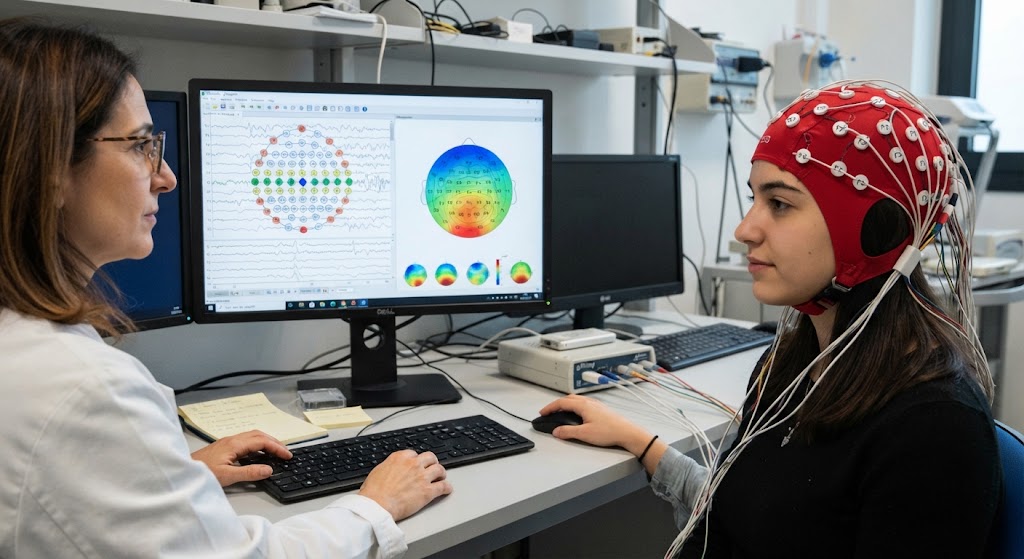
The data collection procedure begins with a simple,
non-invasive procedure in which a clinician or qualified technician
captures a sample of the raw electrical activity of the patient’s
brain, using an "electrode cap" with 10/20 electrode placement (fig.
1).
Sensors in the cap are electrically connected to the
scalp by means of a gel that can be simply washed off with water
after the data recording. The cap is connected to specialised
medical equipment that amplifies the microscopic electrical signals
that the patient’s brain produces and sends those signals to a
computer.
A syringe with a blunt needle is used to squirt
conductive gel into the sensors.
Fig 1. Electrocap used in data collection procedure

Fig 2. Topometric QEEG maps expressed in Z scores (standard
deviations from the norm).
The colour black and two colour bands on either
side (dark red and dark blue) are considered to be within the normal
range. The hotter colours indicate excesses and the colder colours
indicate deficits.
There are hundreds of studies using QEEG
to investigate patterns of brain activity and their associated
behaviours and psychiatric presentations.
Knowledge of these
patterns helps us determine what brain electrical patterns are
associated with ADHD and Learning Difficulties, enabling us to
formulate more targeted treatment strategies.
ReportA key
feature of the report is the probability statement, a highly
distilled reduction of an extremely complex process involving
thousands of data sets. The report also highlights those
characteristics found to be the most significant statistical
contributors to the discriminant findings.
Further, the
report includes full colour topographic maps (fig. 2) and tables
(fig. 3) of data that can be used for more detailed analysis, should
the referring clinician choose to forward the patient data and
report to a specialist for additional interpretation.
Fig 3. Z score tables. The boxed figures are those that exceed 1.96
Standard Deviations
Ease and Safety
The only electricity involved in the cap comes from electrical
activity produced by the patients own brain. No electricity flows
toward the patient. In fact, there is no possibility of the patient
being shocked by the electrical connections as the patient and the
cap are specifically isolated from all of the other equipment. Once
the electrode cap has been put on the patient will need to sit
quietly for a few minutes with eyes closed while the computer
collects a sample of brain wave activity. During data collection,
the patient is asked to minimise movements of the head, blinking,
and clenching of the jaw muscles. Data may also be collected while
the patient gazes softly at a focal point or is engaged in specific
tasks such as reading or while performing a visuo-spatial task on a
computer. The entire recording process usually takes less than an
hour.
Standardised data analysis insures reliability
and validity
Once a sample of the electrical
activity data of the patient’s brain has been collected, the
proprietary software of the acquisition device performs a
computerised transformation of the raw, analog brain waves into
digital form, which can be analysed by the computer. The first phase
of analysis is designed to identify, characterise and highlight
brainwave activity on the basis of its prominent features. Next, the
analysis uses computerised statistical procedures to make over a
thousand statistical analyses to compare patient EEG patterns with
those of a scientific normative database that have been developed
over the past twenty years in major research laboratories and
hospitals.
This procedure provides a sensitive and specific
method to detect subtle variations in the activity of the brain and
quantifies the likelihood that a particular patients profile is
consistent with one or more of the clinical groups in the original
database study.
The results of a brain wave analysis allow
the health care practitioner to determine, in a highly scientific,
objective manner whether, and how, the patients brainwave patterns
are significantly different from what is considered normal for the
patients age group.
Prominent Features
In the first phase of analysis, the patient’s brain wave data
are used to measure the efficiency of electrical interaction between
the brain regions (frontal, temporal, central, parietal, and
occipital) and correlate these findings with the patient’s symptoms
and history. In this first stage of the analysis, computerised
statistical procedures are used to compare patient EEG patterns with
those of a normative, gender and age-matched database. This
statistical process is designed to identify, characterise and
highlight the brainwave activity on the basis of its prominent
features.
Discriminant Equations

Next,
the individual patient QEEG data are compared to a large database of
patients with known disorders. The patients QEEG data are tested
against "discriminant equations," a set of multi variant, derived
measures that facilitate a "pattern recognition" process.
Using the discriminant equations, it is possible, statistically, to
compare the EEG profile of a patient with the profiles found in a
variety of clinical conditions. The discriminant functions quantify
the likelihood (i.e., probability) that a particular patients
profile is consistent with one or more of the clinical groups in the
original database studies. The likelihood of group membership is
then presented as a statistical probability statement.
The
diagram on the left is of a Discriminant function results for a mild
head injury patient indicating that there was a high degree of
probability that the patients EEG still reflects a head injury.
The John’s database can determine with close to 95% accuracy the
following discriminants:
- normal vs. abnormal
- normal vs. depressed
- normal vs. primary degenerative dementia
- normal vs. schizophrenia
- normal vs. mild head injury
- normal vs. learning disability
- normal vs. ADHD
- ADHD vs. Learning Disability
dementia vs. depression
- unipolar vs. bipolar depression
- To detect subtleties of other conditions that need to be
recognized, evaluated, and treated.
FDA Regulation
The clinic uses the Lexicor
Neurosearch NRS24, a 24 channel data acquisition system approved for
medical and research applications. It is regulated by the FDA (US
Federal Drug Administration) and NxLink, a proprietary QEEG software
product also FDA approved containing the John’s QEEG database and
developed by the New York University Medical Centre Brain Research
Laboratories. We also use Neuroguide another FDA approved QEEG
system
Diagnostic Use of the QEEG
Some practitioners associate the science of EEG quantification
exclusively with neurotherapy. This is far from the truth. Aside
from its use as a roadmap to guide EEG operant training, the
quantification of brain wave activity is a powerful diagnostic aid
that transcends treatment modality.
At this time in the
history of psychiatric disorders, a specific strength of QEEG that
is particularly relevant, is its use in guiding decisions about the
use of pharmaceuticals. The past decade has witnessed the launch of
new generations of psychoactive drugs for use with less severe
mental health problems. These drugs have been prescribed with what
some have claimed to be increasing casualness, raising concerns in
the literature about the diagnostic measures on which these
prescriptions have been based.
There is a pressing need for a
tool, such as the QEEG Neurometric report, that offers a powerful
adjunct leading to more accurate and more scientifically measurable
mental health information based on QEEG analysis. As we emerge from
the "Decade of the brain" we have the opportunity of obtaining QEEG
Neurometric reports that may help answer several implicit questions
relating to the underlying neurophysiology:
- Which patients should receive drug treatment?
- Which patients should not?
- What class of drugs might most benefit the patient?
- What changes occur in the patient as the result of
taking the medication?
- Whether global abnormalities may relate to intestinal
dysbiosis and cortical toxicity.
- When the patient’s QEEG is consistent with HPA axis
dysregulation. The QEEG in conjunction with patient history
can provide valuable clues as to whether the aetiology is
due to chronic toxicity from intestinal dysbiosis or food
allergies or from trauma-related HPA hyperactivation.
- Such information guides further investigations and
suggests which neurotransmitter system, serotonergic as
opposed to dopaminergic/noradrenergic, should be targeted
with either medication and/ or nutrient supplementation.
- What changes have taken place as a result of nutrient
supplementation.
- Whether focal abnormalities are best redressed with
neurothearapy.
Through the use of normative and discriminant databases, the
quantification of EEG should prove to be of significant value in
helping clinicians determine the underlying neurophysiology of the
mental health problems of their patients and guide treatment more
effectively.
Bibliography
Amen, Daniel G. Windows
into the A.D.D Mind, Understanding and Treating Attention Deficit
Disorders in the Everyday Lives of Children, Adolescents, and Adults MindWorks
Press, 1997.
Benson, D. Frank. (1991). The
role of frontal dysfunction in Attention Deficit Hyperactivity
Disorder.Journal of Child Neurology, 6 (suppl.), S9-212.
Chabot, R. J., Merkin, Henry, Wood, L.M., Davenport, T.L.,
Serfontein, Gordon, Sensitivity
and Specificity of QEEG in Children with Attention Deficit or
Specific Developmental Learning Disorders,Clinical
Electroencephalography, 1995; Vol. 27 (1) 26-33
Colby, C.L. (1991). The
Neuroanatomy and neurophysiology of attention. Journal
of Child Neurology, 6 (suppl.), S88-S116.
Dawson, R.E., Webster, J.W., & Gurdjian, E.S., (1951) Serial
electroencephalography in acute head injuries. Journal
of Neurosurgery, 8, 613.Duffy, F.H., Hughes, J.R., Miranda, F.,
Bernad, P., Cook, P., Status of Quantified EEG (QEEG) in Clinical
Practice, Clinical Electroencephalography, 1994, 25: 6-22
Gunewald-Zuberbier, E., Grunewald, G., Raske, A. (1975) Hyperactive
behavior and EEG arousal reactions in childhood. EEG
and Clinical Neurophysiology, 38, 149-159.
Dawson, R.E., Webster, J.W., & Gurdjian, E.S., (1951) Serial
electroencephalography in acute head injuries. Journal
of Neurosurgery, 8, 613.
Hughes, J.R., & John, E.R., Conventional
and Quantitative Electroencephalography in Psychiatry,The
Journal of Neuropsychiatry and Clinical Neurosciences, 1999, 11:
190-208
Jasper, H.H., Solomon, P., & Bradley, C. (1938). Electroencephalographic
analysis of behavior problems in children. American
Journal of Psychiatry. 95, 641-658.
John, E.R., Prichep, L.S., Firdman, J., & Easton, P. (1988). Neurometrics:
Computer-assisted differential diagnosis of brain dysfuncitons. Science,
239, 162-169.
Klinkerfuss, G.H., Lange, P.H., Weinberg, W.A., & O'Leary, J.L.
(1965). Electroencephalographic
abnormalities of children with hyper-kinetic behavior. Neurology,
15, 883-891.
Kramer, P. D. (1993) Listening
to Prozac Penguin,
New York
Lubar, J.F., Bianchini, K.J., Calhoun, W.H., Lambert, E.W.,
Brody, Z.H., & Shabsin, H.S. (1985).Spectral analyses of EEG
differences between children with and without learning disabilities. Journal
of Learning Disabilities, 18, 403-408.
Matousek, M., Rasmussen, P., & Gillberg, C. (1984). EEG
frequency analysis in children with so-called minimal brain
dysfunction and related disorders. Advances
in Biological Psychiatry, 15, 102-108.
Mechelse, K., van Gemund, J.J., Nije, J.D., Burg, L., & Laurs,
J., (1975) Visual and
quantitative analysis of EEGs of normal school aged children and
school children with specific reading disability.Electroencephalography
and Clinical Neurophysiology, 39, 106-107.
Niedermeyer, E. & Naidu, S.B. (1997). Attention-Deficit
Hyperactivity Disorder (ADHD) and Frontal-Motor Cortex Disconnection. Clinical
Electroencephalography, 28(3), 130-136.
Satterfield, D.H., Lesser, L.I., Sand, R.E., & Cantwell, D.P.
(1973) EEG aspects of
the diagnosis and treatment of minimal brain dysfunctions. Annals
of New York Academy of Sciences, 205, 273-282.
Thatcher, Robert W., Walker RA, Gerson I, Geisler F. EEG
Discriminant Analysis of Mild Head Trauma, Electroencephalography
and Clinical Neurophysiology, 1989, 73: 94-106
Thatcher, Robert W., QEEG
and Traumatic Brain Injury: Present and Future, Brain
Injury Source, 3: 23-31 1999
Thatcher, Robert W., EEG
Operant Conditioning (Biofeedback) and Traumatic Brain Injury, Clinical
Electroencephalography, 2000; Vol. 31 (1) 38-44.
Winkler, A.W., Dixon, J.F., & Parker, J.B. (1970). Brain
function in problem children and controls: Psychometric,
neurological and electroencephalographic comparisons. American
Journal of Psychiatry, 127, 634-645.
Zametkin, A.J., Rappaport, J.L., (1987) Noradrenergic
hypothesis of attention deficit disorder with hyperactivity: A
critical review. In: Metsler, H.V., (ed.) Psychopharmacology:
The Third Generation of Progress, Raven Press, New York,
837-842.
Zametkin, A.J., Nordahl, T.F., et al., (1990) Cerebral
glucose metabolism in adults with hyperactivity of childhood onset. New
England Journal of Medicine, 323, 20, 1361-1363.