


Our Intensive Early Intervention Services
The Behavioural Neurotherapy Clinic is a Multidisciplinary Healthcare Clinic where staff and associates treat children and adolescents with developmental disorders, ADHD and Autism Spectrum Disorders (ASD), Treatment modalities offered include Psychological interventions, Speech Therapy, Occupational Therapy, Medical treatment, dietary and nutritional interventions. Pivotal Response Treatment (ABA-based therapy) is offered at our client's homes or at the clinic.
Autism Services funded in full by FaHCSIA
- Clinical, Health, Cognitive and Behavioural Psychology and ABA-based Therapies and Interventions.
- Occupational Therapy services provided in-house by an Occupational Therapist.
- Speech Therapy services provided in-house by a Speech Therapist.
Autism Services with Medicare Rebates
- Paediatrician's services provided by an associate Paediatrician.
- Medical services provided in-house by our General Practitioner.
- 4 Sessions for Assessment services (referred by a Paediatrician or child Psychiatrist)
- Psychological services referred under a GP Mental Healthcare plan.for 10 sessions a year for the child
- Psychological services referred under a GP Mental Healthcare plan.for 10 sessions a year for each parent.
- 20 sessions referred by a Paediatrician for Autism treatment
- Clinical Nutrition and Dietary advice as well as nutritional supplementation are provided in-house by a Nutritionist
Focused Interventions for Children with Autism Spectrum Disorders
The staff at the Clinic provides parents of children with ASD and ADHD with a comprehensive service delivery model that uses both a Developmental and Applied Behaviour Analysis approach (based on PRT). When planning and recommending treatment for children with ASD, the following process may take place:
Autism Treatment that Qualify for Funding through Medicare
- GP refers child to a Paediatrician, who may diagnose ASD without referring to Allied Health Professionals (Medicare item 135). Alternatively the Paediatrician makes a referral to Allied Health Professionals for four sessions of assessments and diagnosis for ASD (item 110-120).
- Allied Health Professionals sends assessment report, with a treatment plan, to the Paediatrician.
- The Paediatrician recommends treatment by Allied Health Professional/s for 20 sessions (once in a lifetime service).
- The Paediatrician provides a letter to the family to take to an Autism Advisor at Autism Victoria (Amaze).
- Autism Advisor discusses options with the family and provides a letter entitling the family to access the $6000 a year for two years to be spent in early intensive treatment with an Autism Panel Provider, such as the Behavioural Neurotherapy Clinic.
The following steps qualify for funding through FaHCSIA
- At the Behavioural Neurotherapy Clinic, we recommend treatment based on (a) the individual needs of the child, (b) the results of assessments, (c) the severity of the ASD symptoms, and (d) the preferences expressed by the child’s family.
- We generally recommend parents and therapists to use ABA based on the best of two ABA approaches: Pivotal Response Treatment (PRT) and Discrete Trial Learning (DTL). A Psychologist at the clinic will develop an ABA Program tailored to the developmental needs of the child. PRT has been found in a number of studies to promote motivation, stimulus discrimination, compliance, imitation, speech and generalisation.
- Furthermore the child learns in a naturalistic environment that reduces frustration and tantrums and has fun while learning. PRT was designed to speed up the learning and recovery process and to eliminate the robotic mannerisms often associated with children trained through DTL alone.
- We also provide Speech Therapy and Occupational Therapy as appropriate with our therapists.
- PRT enables all trained care givers to deliver targeted ABA-based therapy to the child in the child’s own natural environment and during normal day to day activities.
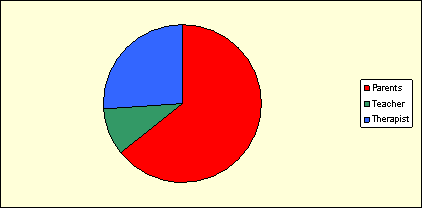
- The following diagram illustrates that parents of autistic children generally spend far more time with their children than teachers and therapists. With parental training in PRT, much of this time can be effectively used in therapy for the child during day-to-day activities
- This can increase the total number of hours of intervention to well over 40 hrs a week. In some cases, this may be the only way that parents can afford the 40 hrs of ABA recommended for effective early intervention of children with ASD.
The following steps are not funded through FaHCSIA, but may attract Medicare rebates
 The GP or nutritionist may check for Red Blood cell Essential Fatty Acids and key Nutritional markers, which research indicates, are often lacking in children with ASD and ADHD. In addition since many children with ASD also have symptoms of Irritable Bowel Syndrome, a Faecal microbiology test is performed by a specialist Laboratory (Bioscreen Medical) at Melbourne University.
- Recommendations are made for dietary changes and nutritional supplementation as needed to normalise nutritional blood markers and increase the child’s chances to optimum health and optimum brain function.
- We do not see this nutritional aspect as a treatment for Autism and ADHD, but rather as a necessary nutritional management of a population of children known to have poor nutritional status as evidenced by Red Blood Cells markers. Although they may not necessarily have caused the deficits, these nutritional factors can maintain brain dysfunction and/or ill health.
Pivotal Response Treatment
According to research, and in our own experience, once acquired, “Pivotal Responses” result in more widespread and generalised improvements in children with Autism than through the exclusive use of “Discrete Trial Learning”. We focus on the following pivotal areas:
- Promoting motivation (by encouraging the child’s own attempts)
- Promoting responsiveness to multiple cues,
- Promoting self-initiation of social and communicative behaviours
- Promoting creative interactive play
- Promoting self-management (e.g. feeding and dressing oneself, toileting etc)
- Promoting recognition of emotional cues and empathy
Environmental relevance and generalisation of skills
 Our everyday world is full of stimuli which flood all our senses constantly. To children with Autism, each of these stimuli appear to be just as meaningless as the other. This lack of “stimulus discrimination” is associated with their lack of engagement with people and with their environment. Parents, siblings, caregivers and trerapists are taught to recognise when the Autistic child finds a stimulus interesting and to pair this spontaneously “discriminated stimulus” with a desirable behaviour, which is rewarded when produced.
Thus, stimulus discrimination is developmentally and environmentally relevant to the child and ABA can be carried out anywhere and at any time by trained parents, siblings and relevant others. Research indicates that PRT encourages generalisation of environmentally relevant behaviours, is more cost-effective, enables more time to be spent with the child for intensive ABA, and is financially more sustainable.
Intensive Early intervention and Motivation
Research suggests that intentional and meaningful communication usually emerges in typical infants as “communicative others” attribute meaning to their actions. Thus infants typically learn that their behaviours, including vocalisation and socialisation, produce consequences and influence others in their environment.
Children with Autism have difficulties making these associations, due to their lack of stimulus discrimination. Hence with PRT, frequently reinforcing stimulus discrimination and associated behaviours encourages children with Autism to make the associations and increases motivation to perform the behaviour. Hence we recommend that parents and all involved with the child learn to apply PRT so that the child can have more intensive, affordable early intervention.
Pivotal Response Treatment Research
Pivotal Response Training arose in response to criticism that many traditional Discrete-Trial Learning interventions did not produce enough generalised learning. The Natural Language Teaching, now called PRT was developed by Koegel (who together with Lovass initially developed DTL) to provide a more naturalistic approach to promoting language and communication in children with Autism [1-11]
The main differences between DTL and PRT are:

- In Discrete Trial Learning the therapist rigidly controls the choice of tasks, contexts and interactions. In PRT the child sets the pace and chooses the contexts. Control of interactions is either shared or initiated by and assigned to the child. The child selects preferred activities which the therapist uses as contexts for communication exchange and learning. Almost every minute of the day offers opportunities for applying ABA therapy using PRT. Opportunities are offered by the therapist and the child is enticed to respond, rather than task selection being imposed on the child.
- PRT uses play and socialisation to focus on increasing motivation by allowing the child to chose learning contexts (encouraging initiation), reinforcing attempts at correct responses, using adequate modeling, and providing naturally desirable consequences.
Overall the therapies provided by the Clinic aim to improve the capability of children with ASD to attend formal school and participate more fully in everyday life.
Developmental and social learning interventions
 This model is concerned with the building of relationships between the child and others and promoting the development of social interactions and socially related emotions. Parents and caregivers are taught that PRT can be used to assist children with Autism to develop an understanding of social roles and social events by teaching the child to be responsive to many learning opportunities and social interactions that occur in the day to day activities in their natural environment. Parents are often surprised that prior to receiving PRT training they missed important teaching opportunities and unknowingly responded in ways that confused the child, increased the child’s frustrations and tantrums and did not promote learning of new skills.
Family-based Interventions
ABA based on PRT can be delivered by trained therapists, parents, and other family members who interact with the child on a day to day basis. Hence we run training courses for therapists and family members to teach them the necessary ABA-based skills. We also work with family members to help them develop skills that are useful in coping with inappropriate behaviours and with their children’s difficulties.
Therapy-based Interventions
Communication, social development and sensory motor integration are continuously promoted through PRT by appropriately trained parents, guided by a program set by the psychologists. However there is often a need, for the involvement of the Speech Therapist and/or the Occupational therapist.
References
- Sherer, M.R. and L. Schreibman, Individual behavioral profiles and predictors of treatment effectiveness for children with autism. J Consult Clin Psychol, 2005. 73(3): p. 525-38.
- Pierce, K. and L. Schreibman, Multiple peer use of pivotal response training to increase social behaviors of classmates with autism: results from trained and untrained peers. J Appl Behav Anal, 1997. 30(1): p. 157-60.
- Pierce, K. and L. Schreibman, Increasing complex social behaviors in children with autism: effects of peer-implemented pivotal response training. J Appl Behav Anal, 1995. 28(3): p. 285-95.
- Koegel, L.K., Interventions to facilitate communication in autism. J Autism Dev Disord, 2000. 30(5): p. 383-91.
- Koegel, L.K., R.L. Koegel, and C.M. Carter, Pivotal responses and the natural language teaching paradigm. Semin Speech Lang, 1998. 19(4): p. 355-71; quiz 372; 424.
- Koegel, L.K., et al., Identifying early intervention targets for children with autism in inclusive school settings. Behav Modif, 2001. 25(5): p. 745-61.
- Koegel, L.K., et al., Improving social skills and disruptive behavior in children with autism through self-management. J Appl Behav Anal, 1992. 25(2): p. 341-53.
- Koegel, R.L., et al., Increasing speech intelligibility in children with autism. J Autism Dev Disord, 1998. 28(3): p. 241-51.
- Koegel, R.L., L.K. Koegel, and E.K. McNerney, Pivotal areas in intervention for autism. J Clin Child Psychol, 2001. 30(1): p. 19-32.
- Koegel, R.L., L.K. Koegel, and A. Surratt, Language intervention and disruptive behavior in preschool children with autism. J Autism Dev Disord, 1992. 22(2): p. 141-53.
- Koegel, R.L., M.C. O'Dell, and L.K. Koegel, A natural language teaching paradigm for nonverbal autistic children. J Autism Dev Disord, 1987. 17(2): p. 187-200.