
Panic Attacks and Anxiety Disorders assessment and therapy in Melbourne
Anxiety Disorder and Panic Attacks share common Biological and Psychological causes. There are many forms of anxiety, some are related to stressful events while others seem to occur for no apparent reason.
This page is presented as psychoeducation. Psychologists at the clinic use CBT and other psychological techniques as evidence-based therapy for anxiety and panic attacks (see below). The nutritionist and GP at the clinic may investigate and treat nutritionaal and IBS-related symptoms as appropriate.
Recent research suggests there may be an association between gut microbiota and anxiety symptoms. Some studies indicate that shifts in gut bacteria may influence neurotransmitter function through the gut-brain axis, potentially contributing to mood and anxiety symptoms in some individuals (Jiang et al., 2024, Frontiers in Neuroscience; Verma et al., 2024, Cells). This is an active and developing area of research, and the clinical significance of these findings is not yet fully established. Current evidence does not support gut microbiota intervention as a primary or standalone treatment for anxiety disorders.
Gut-brain axis in anxiety and panic attacks
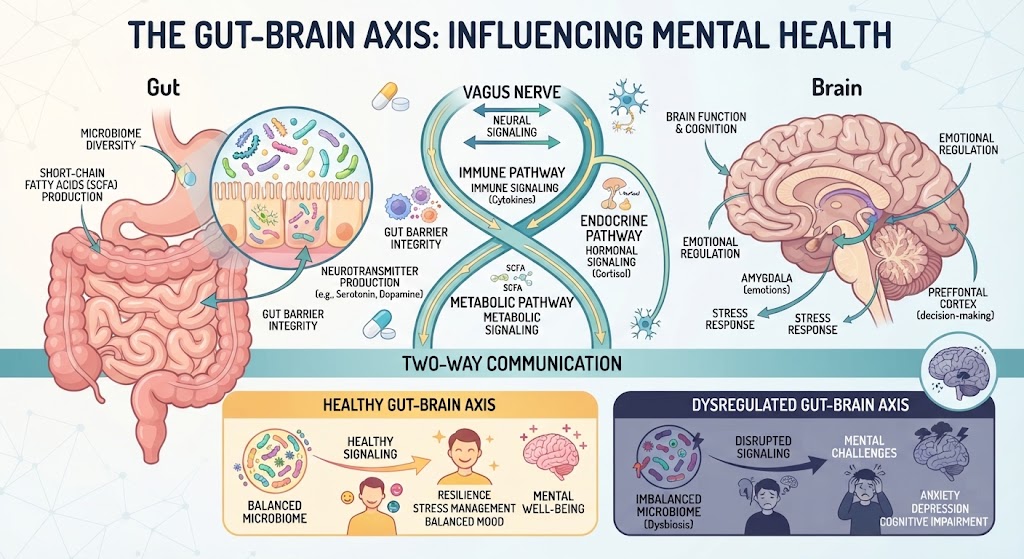
Whilst anyone can experience anxiety and panic attacks, these symptoms often run in families, due to shared genetic factors, as well as diet and nutrient intake which may influence gut bacterial balance. Stressful life events can also trigger anxiety and panic attacks. In some cases, metabolic factors may predispose people to neurotransmitter imbalances, including insufficient essential nutrients or changes in gut bacterial balance (intestinal dysbiosis).
Research has also identified an association between Irritable Bowel Syndrome (IBS) and mood disorders including anxiety and depression (Zamani & Alizadeh-Tabari, 2019, Alimentary Pharmacology & Therapeutics). Where a person with anxiety also experiences gastrointestinal symptoms, it may be appropriate to discuss this with a qualified nutritionist at the clinic to determine whether further assessment is warranted.
Definition of Anxiety Disorders

Anxiety disorders are the most common form of mental illness in Australia. The Diagnostic and Statistical Manual of mental Disorders (DSM-5-TR) defines various types of anxiety disorders which can be grouped under several headings. Please see a qualified psychologist for diagnosis and treatment recommendations.
| A Panic Attack is a discrete period in which there is the sudden onset of intense apprehension, fearfulness, or terror, often associated with feelings of impending doom. During these attacks, symptoms can include shortness of breath, heart palpitations, chest pain/discomfort, choking, ‘smothering’ sensations, as well as fears of "going crazy" or losing control. |
| Agoraphobia is an anxiety or fear about, or avoidance of, places or situations from which escape might be difficult (or embarrassing) in the instance of panic-like symptoms. |
| Panic Disorder Without Agoraphobia is characterised by recurrent unexpected panic attacks of persistent concern. Panic Disorder with Agoraphobia is characterised by both recurrent unexpected panic attacks and agoraphobia. |
| Agoraphobia Without History of Panic Disorder is characterised by the presence of Agoraphobia and panic-like symptoms without a history of unexpected panic attacks. |
| Specific Phobia is characterised by clinically significant anxiety provoked by exposure to a specific feared object or situation, often leading to avoidance behaviours. |
| Social Anxiety Disorder is characterised by clinically significant anxiety provoked by exposure to certain types of social or performance situations, often leading to avoidance behaviours. |
| Obsessive-Compulsive Disorder is characterised by obsessions (which cause marked anxiety or distress) and/or by compulsions (which serve to neutralise the anxiety). |
| Post-traumatic Stress Disorder is characterised by the re-experiencing of an extremely traumatic event accompanied by symptoms of increased arousal and avoidance of stimuli associated with the trauma. |
| Acute Stress Disorder is characterised by symptoms similar to those of post-traumatic stress disorder that occur immediately in the aftermath of an extremely traumatic event. |
| Generalised Anxiety Disorder is characterised by at least 6 months of persistent and excessive anxiety and worry. |
| Anxiety Disorder Due to a General Medical Condition is characterised by prominent symptoms of anxiety that are judged to be a direct physiological consequence of a general medical condition. |
| Substance-Induced Anxiety Disorder is characterised by prominent symptoms of anxiety that are judged to be a direct physiological consequence of drug abuse, medication, or toxin exposure. |
| Anxiety Disorder Not Otherwise Specified is included for coding disorders with prominent anxiety or phobic avoidance that do not meet criteria for any of the specific Anxiety Disorders defined in this section (or anxiety symptoms about which there is inadequate or contradictory information). |
Anxiety Disorders in Children and Adolescents
The DSM-5-TR identifies separation anxiety disorder as specific to children, defined as excessive or developmentally inappropriate anxiety about separation from home or attachment figures. In some children this presents as school avoidance. Children and adolescents may also be diagnosed with panic disorder, phobias, generalised anxiety disorder, and post-traumatic stress disorder.
What Triggers Panic and Anxiety?
Anxiety is a normal adaptive response to perceived threat. It becomes disordered when that response is exaggerated or occurs out of context. Stressful life events are a common trigger, though attacks can also occur without an obvious cause. Some people have a biological or genetic predisposition that increases their susceptibility. Research supports the role of neurotransmitter imbalances in anxiety, and antidepressant and anti-anxiety medications can be effective for many patients as a result.
Catastrophising
The physical symptoms of a panic attack — palpitations, chest tightness, dizziness — do not indicate a physical problem with the heart or other organs. They arise from an overdrive of nervous system activity during panic. The real problem is the misinterpretation of these normal sensations as signals of danger, creating a vicious cycle: physical sensations lead to catastrophic thoughts, which intensify the sensations further. Understanding this mechanism is an important step in managing panic. If you are concerned about your anxiety symptoms, speaking with a qualified psychologist is recommended.
Symptoms of a Panic Attack
Common symptoms include palpitations, sweating, trembling, hot flushes or chills, shortness of breath, chest pain, nausea, dizziness, fear of dying or losing control, numbness or pins and needles, and feelings of unreality or depersonalisation. Many people hyperventilate during a panic attack, which alters blood acidity and can worsen symptoms such as dizziness and cramps. A panic attack typically lasts 5–10 minutes, though symptoms can come in waves for up to two hours.
Psychological Treatment
Assessment and Support at BNC
Our psychologists conduct a thorough assessment to understand the specific type of anxiety or panic symptoms you or your child are experiencing, and to rule out other contributing factors. Assessment and therapy are available in person at our Doncaster clinic or by Telehealth (Zoom), for children, adolescents and adults.
You can access support at BNC through referrals from parents, carers, GPs, schools, or other health professionals. With a referral and Mental Health Care Plan (MHCP) from your GP, or a referral from a paediatrician or psychiatrist, you may be eligible for Medicare rebates for up to 10 sessions per calendar year. Rebates may also be available through your private health fund — check with your insurer for details.
Anxiety and depression often occur together. If this sounds familiar, our pages on Depression: Types, Causes & Symptoms and the Signs of Childhood Depression may also be helpful.
Frequently Asked Questions
What's the difference between anxiety and a panic attack?+
Are panic attacks dangerous?+
Can children have panic attacks or anxiety disorders?+
What is agoraphobia?+
How is anxiety diagnosed?+
What is the best treatment for panic disorder and anxiety?+
Is Telehealth available, and are sessions covered by Medicare?+
Cognitive behavioural therapy (CBT) is the first-line psychological treatment for anxiety disorders and panic disorder, with a robust evidence base across peer-reviewed studies and clinical guidelines (Pompoli et al., 2016; Locke et al., 2015; Bandelow et al., 2017).. CBT addresses the thought patterns and behaviours that maintain anxiety through techniques including exposure, cognitive restructuring, and skills training, and is associated with lower relapse rates than medication alone. Other therapies with research support include applied relaxation, psychodynamic therapy, and mindfulness-based approaches, selected based on individual needs and preferences.
Updated on: 01/03/2026 by Dr Jacques Duff - BA Psych; Grad Dip Applied Psychology PhD
Reviewed on: 05/03/2026 by: Bernard Ferriere- Clinical Psychologist; BA; Grad Dip Applied Psychology; Dip Clinical Hypnosis; MAPS